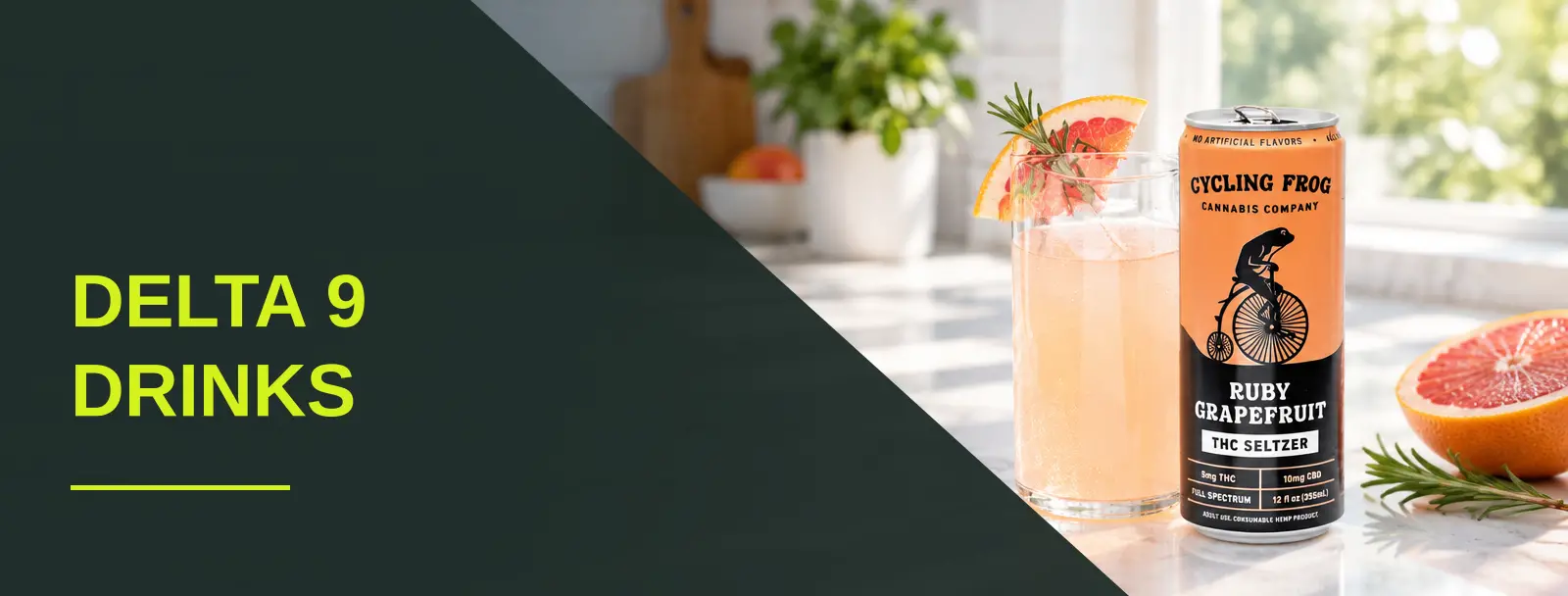
Delta 9 Drinks: Legality, Dosing and How to Pick One
How does a can of THC seltzer end up in a cooler in North Carolina, a state with no recreational cannabis program? The short answer is arithmetic. The longer answer involves a 2018 farm law, a percentage, and a deadline that's coming up fast.
Our delta 9 drinks are seltzers and drink enhancers infused with hemp-derived Delta 9 THC (tetrahydrocannabinol), the compound behind the euphoric effects of cannabis. Today they're federally legal under the 2018 Farm Bill until a new federal hemp definition takes effect on December 11, 2026 (more on that below).
This guide covers how THC gets into a can, why the 0.3% rule allows it, how to read a label, and how to pick a strength that suits you. If you're new to all of this, good. You're exactly who we wrote it for.
Table of contents
- What are delta 9 drinks, exactly?
- Are delta 9 drinks legal? The 0.3% hemp threshold explained
- How fast do THC beverages kick in?
- Delta 9 drink dosage: how many milligrams should you start with?
- How to shop for hemp-derived THC drinks
- The delta 9 seltzers and drinks in our cooler
- Delta 9 drinks FAQ
- Finding your sweet spot
What are delta 9 drinks, exactly?
A delta 9 drink is a beverage with a measured amount of Delta 9 THC in it, printed on the label in milligrams. Most are sparkling waters or seltzers. You'll also see sodas, teas, mocktail-style cans, and drink enhancers you stir into whatever's already in your glass.
The THC comes from hemp, and it's the same molecule found in any other cannabis plant. For the background on the cannabinoid itself, our beginner's guide to Delta 9 starts from zero.
How THC gets into a can
THC is an oil, and oil doesn't mix with water. Pour cannabis extract straight into seltzer and it floats to the top or clings to the inside of the can.
Drink makers get around this with an emulsion. They break the extract into very small droplets and coat them with an emulsifier, which keeps the THC spread evenly through the liquid. It's the same basic trick that keeps a bottled salad dressing from separating, done at a much smaller scale. In a well-made drink, the first sip and the last sip carry about the same amount of THC.
Delta 9 drinks vs. edibles
So why pick a can over a gummy? Mostly pacing. A gummy is one fixed serving you eat all at once. With a drink, you can sip it over half an hour, split it with a friend, or pour half now and half later. That gives you more say over how much THC you take in and how quickly.
There's a social side too. A can in your hand at a cookout looks like what everyone else is holding. For plenty of people, that's the entire appeal.
You swallow and digest both, so neither one is instant.
Are delta 9 drinks legal? The 0.3% hemp threshold explained
Today, yes, at the federal level. That answer has an expiration date.
What the 2018 Farm Bill says
The Agriculture Improvement Act of 2018 (Public Law 115-334), signed on December 20, 2018, removed hemp from the federal definition of marijuana. It defines hemp as the cannabis plant and its derivatives, extracts, and cannabinoids with a Delta 9 THC concentration of no more than 0.3% on a dry weight basis.
Read that again and you'll notice the limit is a percentage of weight. It says nothing about milligrams per serving.
The math behind a 5 mg can
A 12-ounce can of seltzer weighs about 355 grams. Three tenths of one percent of 355 grams is 1,065 milligrams. A drink with 5 mg of Delta 9 THC comes in around 0.0014% by weight, and a 10 mg can is about 0.0028%. Both sit far under the line.
One caveat. "Dry weight" was written with plant material in mind, and applying it to a finished liquid is the hemp industry's common reading. The statute doesn't spell it out for beverages. That reading is what has put these products on shelves since 2018, and we walk through the same math for edibles in our post on how 0.3% adds up to a real gummy.
It still surprises us that a rule written for field crops ended up deciding what goes into a seltzer.
What changes on December 11, 2026
Here's where things get interesting. A federal spending law signed in November 2025 rewrites the hemp definition, and the new version takes effect on December 11, 2026.
Two things change. First, the new definition counts total THC instead of Delta 9 alone. Total THC includes THCa (tetrahydrocannabinolic acid), the raw form that turns into Delta 9 THC when heated, a process called decarboxylation. Second, it caps finished hemp products at 0.4 mg of total THC per container.
A 5 mg can holds more than 12 times that amount. So after that date, delta 9 drinks as they exist now, along with products like Delta 9 gummies, won't count as hemp under federal law. That's the law as written today, and we'd rather you hear it from us than from an empty cooler.
States are a separate layer. Some cap the milligrams per serving, some limit where THC beverages can be sold, and some don't allow them at all, so what's available to you depends on where you live. If we can't send an item to your address, our checkout will say so before you pay.
How fast do THC beverages kick in?
It depends on the drink, and it depends even more on you.
Onset and duration
Published pharmacokinetic research on oral THC generally describes effects beginning 30 to 90 minutes after swallowing and lasting several hours. That's the baseline for anything you eat or drink.
Drink makers often advertise a quicker onset than gummies. Some published research on emulsified cannabinoid formulations does suggest they may be absorbed faster than oil-based ones, but how much faster varies with the formulation and with the person drinking it. Take any onset time printed on a can as a rough guide.
A drink also doesn't arrive all at once the way a gummy does. If you take 40 minutes to finish a can, the THC enters your system over that stretch too.
Why experiences vary
Your tolerance, your body, and what you've eaten all play a part. Published research on oral cannabinoids has found that a meal, especially a high-fat one, can change how much gets absorbed and when. Two friends can split a four-pack and have very different evenings.
Ingredients matter too. Some delta 9 drinks pair THC with CBD (cannabidiol) or other cannabinoids. The idea that these compounds work together is called the entourage effect, and the research behind it is still preliminary. Our post on full spectrum vs isolate gummies covers what's known so far.
Delta 9 drink dosage: how many milligrams should you start with?
Fewer than you think. Probably fewer than the person next to you.
What the numbers on the can mean
Across the category, most cans list somewhere between 2 and 10 mg of Delta 9 THC, and some go higher. Those figures are label conventions. They aren't medical guidance, and the same number can land differently for two people.
Our opinion? If it's your first can, pick the lowest number in the cooler. You can always step up next time.
Check the serving size while you're at it. Some cans count as two servings, so the big number on the front might be the total for the can or the amount per serving. The nutrition panel settles it.
Start low, go slow
Take a few sips or pour half a can, then give it time. The classic mistake is opening a second can because the first one hasn't shown up yet. With an onset window as wide as 30 to 90 minutes, waiting is the whole strategy.
Plan the evening around staying put. Skip driving and anything else that needs your full attention while the effects last.
If you ever take in more than you meant to, know that effects vary from person to person and pass with time. Anyone who's worried should contact a medical professional or Poison Control.
How to shop for hemp-derived THC drinks
Flavor, format, ingredients, and strength all have a part to play. There's more to finding the right product than picking the highest number on the label.
Reading the label
Start with the milligrams of Delta 9 THC per can and per serving. Then look at what else is in there: other cannabinoids such as CBD, sugar and calories, caffeine, sweeteners. A zero-sugar lime seltzer and a full-sugar root beer are very different drinks even at the same THC strength.
Find the batch or lot number too. You'll need it for the next step.
Reading the COA
A COA (Certificate of Analysis) is a report from an independent lab, and it's what "third-party tested" refers to. On a beverage COA, check three things:
- The Delta 9 THC result lines up with the label.
- The batch number matches your can.
- The test date is reasonably recent.
Fuller reports also include panels for pesticides, heavy metals, and microbes.
On our product pages you can compare product details and available lab results, then choose what suits your preferences. If a report confuses you, ask us. Lab results are one of the questions our team answers most.
The delta 9 seltzers and drinks in our cooler
We stock CannaBuddy's own seltzers alongside a selection of other cannabis brands, and the lineup shifts as new flavors and batches arrive. A ranked list would go stale in a month, so here's how we'd sort the THC seltzers and drink enhancers on the shelf.
Sort by strength first. Lower-milligram cans suit a first try, and the higher-milligram ones are there for people who already know their sweet spot.
Then flavor, because a drink you don't like is a drink you won't finish. A can that's too sweet for you won't be saved by its cannabinoid profile. Read the ingredients the way you would for any other seltzer.
Format comes last. A can is one sealed, labeled amount. A drink enhancer goes into a beverage you already like, which is handy if you have a favorite sparkling water and no interest in switching.
Comparing cannabinoids? We keep Delta 8 drinks in their own category.
If you'd rather shop in person, we have two dispensary locations in Charlotte and Matthews, NC, where you can see the products up close and talk with our team.
Delta 9 drinks FAQ
Are delta 9 drinks legal in my state?
At the federal level, hemp-derived delta 9 drinks are legal today under the 2018 Farm Bill until a new federal hemp definition takes effect on December 11, 2026. After that, federal law caps hemp products at 0.4 mg of total THC per container, which rules out the cans sold now. States add their own rules on top, and those range from milligram caps to outright bans.
How long do the effects of a delta 9 drink last?
Published research on oral THC describes effects that last several hours, and longer for some people. The amount you drink, your tolerance, and what you've eaten all shift the timeline. Keep your schedule clear the first time.
Can you mix delta 9 drinks with alcohol?
We'd keep them separate. Some published research has found higher THC levels in the blood when alcohol and cannabis are used together, and combining them makes it hard to tell what each one is doing. Pick one for the night.
Will delta 9 drinks show up on a THC screening?
They can. Hemp-derived Delta 9 THC is the same molecule as Delta 9 THC from any other cannabis plant, and a screening looks for THC metabolites, not where the THC came from. If you're screened for work or any other reason, assume a THC drink counts.
Do delta 9 drinks need to be refrigerated?
Go by the can. Storage directions vary by brand and are printed on the label. Wherever you keep them, use locked storage, out of reach of children and pets. A THC seltzer looks a lot like a regular one.
Finding your sweet spot
If we were handing you a first can, it'd be a low-milligram seltzer in a flavor you'd drink anyway, on a night with nothing on the calendar. Sip it slowly. See what you think.
Finding your favorite starts with a good Buddy. Browse the full Delta 9 drinks lineup online, or stop by our Charlotte or Matthews shop and we'll walk you through the cooler ourselves.