Live Resin Gummies: What They Are & How They’re Made
You're standing in front of two gummy packages. Same cannabinoid, same milligrams, same flavor. One says "live resin" on the front and often costs more. So what are you actually paying for?
Here's the short version. Live resin gummies are edibles made with an extract from cannabis that was flash-frozen right after harvest instead of being dried and cured the traditional way. That freezing step is the entire reason the term exists. It's meant to hold onto the plant's aromatic compounds (terpenes) that would otherwise evaporate during drying.
That's the promise, anyway. Whether a given gummy delivers on it depends a lot on the brand making it.
In this post, we'll walk through what live resin is, how it ends up in a gummy, how live resin edibles compare to the distillate gummies most people are used to, and, most importantly, how to tell if a label's claims hold up. If you'd rather skip ahead and browse, our live resin gummies collection is right here.
Table of contents
- What is live resin? (Start with the freeze)
- How are live resin gummies made?
- Live resin gummies vs. distillate gummies: what actually changes?
- How long do live resin gummies take?
- How to choose quality live resin gummies
- Are live resin gummies legal?
- Live resin gummies FAQ
- The Bottom Line on Live Resin Gummies
What is live resin? (Start with the freeze)
Let's back up to the plant.
When cannabis is harvested the conventional way, it goes through a drying phase (usually a week or two hanging in a controlled room) and then a curing phase (weeks to months in sealed containers). Only after that does it get extracted into a concentrate. This is how it's been done for a long time, and it works fine for a lot of products.
The catch is what happens during that drying window. Terpenes, the volatile compounds that give cannabis its smell and flavor, are, well, volatile. They evaporate. The lightest, most delicate ones go first. By the time the plant is cured and extracted, a chunk of the original aromatic profile has simply left the building.
Live resin skips the drying step entirely. The plant is frozen within hours of harvest, typically at very cold temperatures, and stays frozen until extraction. The idea is to capture the terpene profile the plant had while it was still "alive." Hence the name.
Think of it like the difference between fresh basil and the dried stuff in your spice rack. Same plant. Not remotely the same flavor.
If you want the full deep dive on the extract itself, our guide to how live resin is made covers it. This post focuses on what happens once that extract becomes a gummy.
Why flash-freezing matters for terpenes
The logic is simple: terpenes are volatile, so skipping the drying window should keep more of them. The published evidence is thinner than the marketing suggests, though. A 1996 study in the Journal of Natural Products compared the steam-distilled volatile oil of fresh and air-dried cannabis buds (Ross & ElSohly, 1996) and reported that drying had no effect on the oil's qualitative composition. That study looked at flower, not gummies, and it measured composition rather than how much oil was left, so don't stretch it in either direction. How much a given gummy keeps depends on the strain, the freezing process, the extraction, and what happens afterward. Which brings us to a point we'll keep hammering: there's no universal number here.
Live resin vs. live rosin: not the same thing
People mix these up constantly, and the names don't help. (We compare the two as gummies in a separate post: live resin gummies vs. live rosin gummies.)
Both start with flash-frozen cannabis. The difference is how the good stuff gets pulled out. Live resin uses a solvent (usually a hydrocarbon like butane or propane) that is then purged off under vacuum. Live rosin uses only heat and pressure, no solvent at all. Rosin tends to be pricier because the yields are lower and the process takes more labor.
Neither is automatically "better." They're just different routes to a terpene-rich concentrate.
How are live resin gummies made?
So how does frozen plant material turn into something chewy?
The frozen cannabis goes through extraction, the solvent gets purged, and what's left is live resin: a sticky, aromatic concentrate. From there it gets blended into a gummy base (pectin or gelatin, sugar, flavoring, citric acid) that's been heated so the ingredients combine, then poured into molds, set, and packaged. Pretty straightforward on paper.
Here's where things get interesting. That heating step is a second chance for terpenes to escape. The same volatility that makes them vanish during drying makes them vanish from a warm gummy mixture, too. A careful manufacturer adds the extract late in the process, at the lowest workable temperature, and packages quickly. A less careful one doesn't. In that case the "live resin" on the label describes an ingredient that went in, not what's left when you open the bag.
Then there's shelf time. Terpenes keep slowly fading after packaging. A gummy that's been sitting in a warm warehouse for eight months won't taste or smell like it did on day one.
This is why third-party lab testing matters so much for this category specifically. A good Certificate of Analysis (COA) for a live resin gummy should show residual solvent results, confirming the hydrocarbon was properly purged, alongside cannabinoid potency.
"Live resin gummies" vs. "gummies with live resin terpenes": read the label
This is the part most articles skip, and it's probably the most useful thing on this page if you're an experienced buyer.
Not every gummy labeled "live resin" is made the same way. Some use actual live resin extract as the cannabinoid source, meaning the Delta 9 THC, minor cannabinoids, and terpenes all come from that frozen-plant concentrate. These are closer to what people mean by full spectrum gummies.
Others use distillate for the cannabinoids (a refined extract with most of the terpenes stripped out) and then add back terpenes that were collected from live resin. The cannabinoid content might be nearly identical. The terpene content might be, too. But the origin is different, and some folks care about that.
Neither approach is wrong. The problem is that packaging rarely makes the distinction clear, and "live resin" isn't a regulated term on hemp products. Anyone can print it.
Here's our honest take: if a brand puts "live resin" on the package but won't show you a terpene panel on the COA, the words don't mean much. A potency test tells you the milligrams. Only a terpene panel tells you whether the thing that makes live resin live resin actually survived.
Live resin gummies vs. distillate gummies: what actually changes?
This is the head-to-head most people searching "live resin vs distillate gummies" want. Let's lay it out plainly.
| Live Resin Gummies | Distillate Gummies | |
|---|---|---|
| Starting material | Flash-frozen cannabis | Dried and cured cannabis |
| Terpene content | Typically broader, brand-dependent | Minimal, unless terpenes are added back |
| Flavor | Often described as more strain-specific and plant-forward | Often described as cleaner and more neutral |
| Price | Usually a bit higher | Usually lower |
Distillate is a highly refined extract: essentially an isolated cannabinoid with almost everything else removed. It's consistent, it's affordable, and it's the backbone of most Delta 9 gummies and Delta 8 gummies on the market. There's nothing wrong with it.
Live resin brings a wider cast of characters to the party: the primary cannabinoid, minor cannabinoids, and whatever terpenes made it through processing.
Now, the question everyone really wants answered: is live resin stronger?
Not in the way people usually mean. Potency is a milligram question, not an extraction question. A 10 mg live resin Delta 9 gummy and a 10 mg distillate Delta 9 gummy contain the same amount of Delta 9 THC. What may differ is flavor and aroma. Even that varies by product.
The entourage effect, explained honestly
The entourage effect is the proposed idea that cannabinoids and terpenes may work together in ways that differ from cannabinoids on their own. Dr. Ethan Russo's 2011 review in the British Journal of Pharmacology, "Taming THC," is the paper most people cite, and it lays out the hypothesis in detail.
Notice the words "proposed" and "hypothesis." The research is still developing, and it's not settled science. Anyone who tells you otherwise is overselling. If you want to go deeper, our post on full spectrum vs. isolate Delta 9 gummies and the entourage effect gets properly nerdy about it, and our terpenes guide covers the compounds themselves.
Flavor and aroma
Flavor and aroma are the difference that doesn't require a lab to check, and also the one we can't describe for you. The Erth Wellness listings are named by strain (Wedding Cake, Jack Herer, Granddaddy Purple, Northern Lights, GG#4), and the Wedding Cake listing describes subtle sweetness layered with earthy undertones. Whether you prefer that to a straightforward strawberry gummy is a preference, not a quality verdict.
How long do live resin gummies take?
Like any edible, live resin gummies take their time. A 2016 review of cannabis edibles, "Tasty THC: Promises and Challenges of Cannabis Edibles", puts the initial effect of Delta 9 edibles at 30 to 90 minutes, with a peak around 2 to 4 hours after ingestion, and notes that weight, metabolism and eating habits all play a role. Nothing about the word "live resin" changes that clock.
Dosing: start low, go slow
Same rule as every edible, and it matters just as much here.
The Erth Wellness listings are a useful model: each gummy is 10 mg of Delta 9 THC, and the suggested use is half a gummy (5 mg) for first-time or new users, one full gummy (10 mg) for experienced users, then waiting up to 2 hours before considering more. Cutting a piece in half is completely reasonable. The most common edible mistake is taking a second piece at the 45-minute mark because "it isn't working yet," and then having both hit at once.
Experienced consumers can scale from wherever they're already comfortable. Just remember that the milligrams matter, not the word "live resin." A 25 mg live resin gummy is still a 25 mg gummy.
How to choose quality live resin gummies
Since "live resin" isn't regulated on hemp products, the burden of verification lands on you. Here's what to look for.
- A Certificate of Analysis from a third-party lab. Not optional. And look for one that includes a terpene panel, not just cannabinoid potency.
- Residual solvent testing. Live resin extraction usually involves hydrocarbons. A good COA confirms they were purged.
- Clear milligram labeling per gummy and per package. If you have to do math to figure out your dose, that's a yellow flag.
- Whether the product is made with live resin extract or distillate with live resin terpenes added. A brand that's proud of its process will tell you.
- A company that answers emails. Seriously, ask them how they add the extract to the gummy base. The good ones have an answer ready.
At CannaBuddy, we don't carry every live resin gummy on the market. Right now the live resin gummies in stock are from two brands:
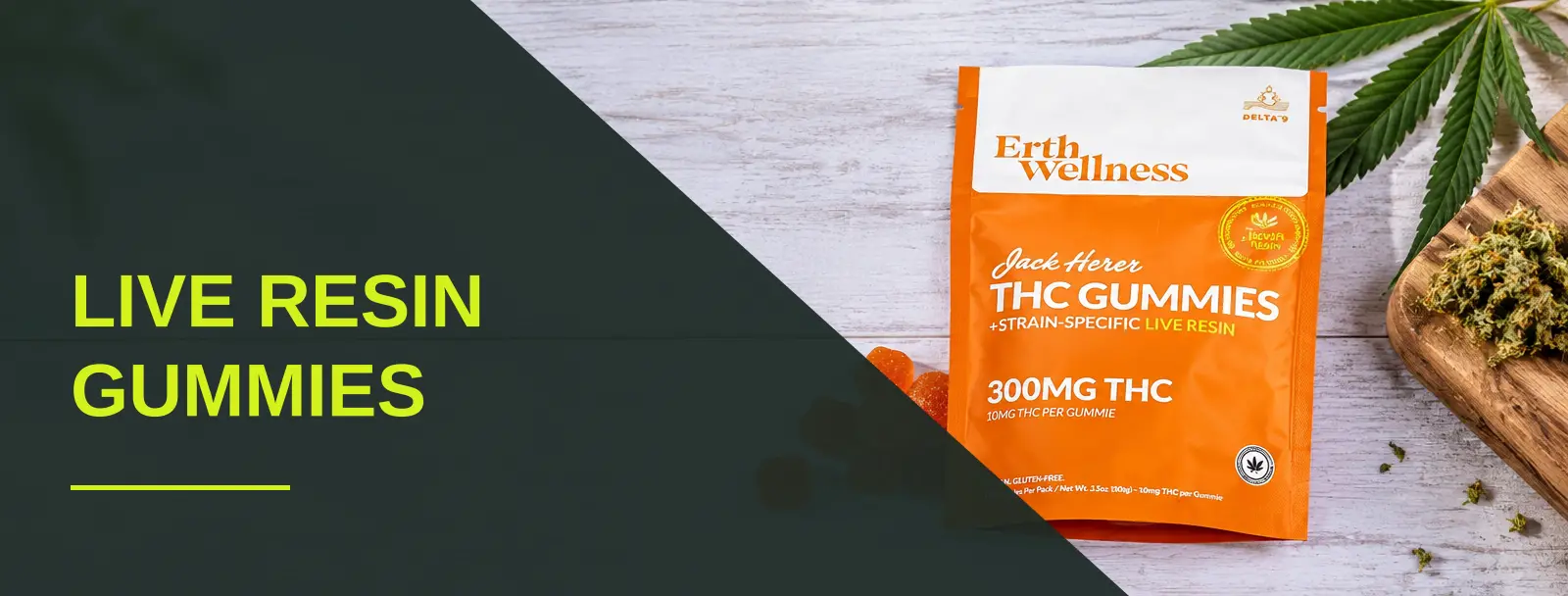
- Erth Wellness: Delta 9 THC live resin gummies in five strain-named flavors (Wedding Cake, Jack Herer, Granddaddy Purple, Northern Lights and GG#4). Each bag has 30 gummies at 10 mg Delta 9 THC each, 300 mg per bag, and the listings say the live resin comes from flash-frozen flower.
- Urb: Delta 9 THC / HHC Live Resin Gummies in Coconut Cream, with 10 mg Delta 9 THC plus 15 mg HHC per gummy and 20 gummies per package.
Every product page links its COA, and you can browse more on our Lab Results page before you buy. Then use the checklist above on them, and on us. For example, the Erth Wellness Wedding Cake report (Anresco Laboratories, reported May 13, 2026) lists passes for the microbiological, pesticide, residual solvent, heavy metal and mycotoxin screens and measured 9.80 mg of Delta 9 THC per gummy against 10 mg labeled, but it is not a terpene panel. And the Urb Coconut Cream ingredient panel lists the cannabinoids as distillate, which is exactly the label-reading situation described earlier, so check what "live resin" means on that package.
Are live resin gummies legal?
Under the 2018 Farm Bill, hemp-derived products containing no more than 0.3% Delta 9 THC by dry weight are federally legal in the United States. That's the framework that allows hemp-derived live resin gummies to be sold online and shipped to many states.
Two things worth being clear about. First, "hemp-derived" is the operative phrase. The live resin process itself has nothing to do with legality. What matters is where the cannabinoids came from and how much Delta 9 THC the finished product contains. Second, state laws vary and change often. Some states restrict certain hemp-derived cannabinoids regardless of federal status.
Always check your local and state regulations before ordering.
Live resin gummies FAQ
What are live resin gummies?
Live resin gummies are edibles made with an extract from cannabis that was flash-frozen immediately after harvest, skipping the traditional drying and curing steps. The goal is to retain more of the plant's terpenes, which otherwise evaporate during drying.
Are live resin gummies stronger than regular gummies?
Not in terms of potency. A 10 mg live resin gummy contains the same amount of Delta 9 THC as a 10 mg distillate gummy. The flavor and aroma may differ because of the broader terpene and cannabinoid profile, but milligrams determine strength.
Do live resin gummies taste different?
Often, yes. Live resin gummies are typically described as having a more strain-specific, plant-forward flavor and aroma than distillate gummies, which tend to be more neutral. Some people prefer it; some don't.
What's the difference between live resin and live rosin gummies?
Both use flash-frozen cannabis. Live resin is extracted with a solvent (then purged), while live rosin uses only heat and pressure. Rosin is solventless and typically more expensive because the yields are lower.
How long should I wait before taking more?
A 2016 review puts the initial effect of Delta 9 edibles at 30 to 90 minutes, sometimes longer with food in your system. Wait at least 90 minutes to 2 hours before considering a second dose. Still have questions? Our FAQ page covers shipping, dosing, lab testing, and more.
The Bottom Line on Live Resin Gummies
So, are live resin gummies worth it? If you're curious about flavor and a fuller terpene profile, absolutely give them a try. If you just want a reliable gummy at a lower price, distillate will do the job fine. Either way, the honest move is the same one we'd tell a friend: pull up the COA, look for the terpene panel, and buy from someone who'll show you their work.
Ready to compare for yourself? Browse our live resin gummies and start low, go slow, and find what works for you.