Vegan and Gluten-Free Delta 9 Gummies: How to Read the Ingredient Label
Most gummies on earth start the same way: with gelatin. Pull a random bag off a gas-station shelf and odds are you're chewing processed animal collagen. Hemp gummies aren't exempt. Plenty of "fruit-flavored" Delta 9 gummies lean on gelatin, and plenty of the ones that don't still hide an animal-derived ingredient three lines further down the label.
So if you're plant-based, or you're shopping around a wheat allergy, a dairy allergy, or a dietary rule that matters to you, you've probably learned to read the fine print before you read the flavor name.
Good. This article is for you.
Quick definition first. Hemp-derived Delta 9 THC (delta-9-tetrahydrocannabinol) is the same cannabinoid found in traditional cannabis, produced from hemp and kept at or below 0.3% by dry weight to fit the 2018 Farm Bill's definition of legal hemp. In a gummy, that math works out to more per piece than most people expect. More on that in the FAQ.
Below, we get into what makes a gummy vegan in the first place, how to read a label like someone who's been fooled before, and which gummies on our shelf actually say vegan on their listings. Those all come from our Delta 9 gummies collection.
Table of contents
- Are Delta 9 gummies vegan? Usually not, and here’s why
- Pectin vs. gelatin: what’s actually different?
- Vegan vs. gluten-free: not the same thing
- How to read an allergen statement on a Delta 9 gummy
- What our gluten-free page actually tells you
- Vegan Delta 9 gummies we carry at CannaBuddy
- Dosing vegan Delta 9 gummies: start low, go slow
- Vegan Delta 9 gummies FAQ
- Your Plant-Based Shortlist
Are Delta 9 gummies vegan? Usually not, and here's why
Gelatin, the obvious one
Gelatin is collagen pulled from animal skin, bones, and connective tissue, usually pork or beef. It's cheap, it sets reliably, and it produces the bouncy chew people expect from a gummy. That's why most commercial gummies run on it. You knew this part. Moving on.
The ingredients that sneak past vegan shoppers
This is where even careful readers get caught.
- Beeswax or shellac. Both show up as anti-stick coatings. Shellac usually hides under the name "confectioner's glaze," and it's secreted by lac insects. Beeswax needs no explanation.
- Carmine. Red and pink gummies sometimes get their color from cochineal insects. On a label it might read "carmine," "cochineal extract," or "natural red 4."
- Vitamin D3. Some wellness-style formulations add it, and the common source is lanolin, the grease from sheep's wool. Lichen-derived D3 exists, but labels rarely say which you're getting.
- Honey, tucked into "natural sweetener blends."
- Glycerin. Could be soy. Could be palm. Could be tallow. The ingredient line almost never specifies.
- Cane sugar. Some refineries filter it through bone char. Many vegans treat this as a gray area and don't sweat it; others do. We're not here to referee. We'll just point out that a "vegan" badge on the front panel doesn't always mean the manufacturer checked all the way down.
If a label says "natural flavors" or "natural colors" and stops there, you're entitled to ask the manufacturer what that means. The good ones answer. The ones that don't are telling you something too.
Pectin vs. gelatin: what's actually different?
Where each one comes from
Pectin is a soluble fiber extracted mostly from citrus peel and apple pomace (the pulp left over after juicing). Gelatin is partially hydrolyzed collagen. One is a byproduct of the juice industry, the other a byproduct of the meat industry.
You'll occasionally see agar (from seaweed) or tapioca starch doing the same job in plant-based Delta 9 gummies. Both are vegan. Both are less common than pectin because they're fussier to work with at scale.
Texture, bite, and the summer-shipping problem
Each one has tradeoffs.
Gelatin gummies are bouncy. They have that long, elastic chew, the classic bear texture, and they soften right around body temperature, which is part of why they feel the way they do in your mouth. Pectin gummies are softer, with a shorter bite that breaks rather than stretches. Closer to a fruit snack than a gummy worm.
Pectin also holds its shape in heat better. If you order online, that matters: a July porch doesn't care how nicely your package was packed. (The Wana listings we carry describe their gummies as melt-proof.)
Honestly? Once you get used to a pectin gummy, gelatin starts to feel like chewing a rubber band. That's our texture opinion and says nothing about quality. Plenty of people love the bounce.
Does the gelling agent change the effects?
No evidence says it does. We hear the "pectin hits faster" line constantly, and we'd love to find a study backing it up, because it would make a great marketing bullet. There isn't one.
How quickly an oral THC product comes on, and how long it lasts, depends on digestion: what's in your stomach, how much fat you ate, how your liver processes the compound, your own metabolism. It doesn't depend on whether the gummy was set with fruit fiber or collagen. Oral THC absorption is slow and variable to begin with, with peak blood concentrations typically arriving one to two hours after ingestion and sometimes later (Huestis, Chemistry & Biodiversity, 2007). The gelling agent is a vanishingly small variable in that equation.
If you want the full breakdown on how edibles move through your body, we go deeper in our post on how long Delta 9 gummies take to start working.
Vegan vs. gluten-free: not the same thing
Here's a mistake we see weekly: shoppers assume that if a gummy is vegan it's gluten-free, or the other way around. Neither follows.
A gelatin gummy can be perfectly gluten-free. Gelatin has nothing to do with wheat. Meanwhile a pectin gummy (plant-based, no animal ingredients anywhere) can be built on wheat-derived glucose syrup or flavored with malt. Vegan, yes. Gluten-free, no.
The big unknown is modified food starch. It can come from corn, potato, tapioca, or wheat, and in the hemp space the label often doesn't bother to say which.
So you're really running two separate checks.
For vegan: gelling agent, coating, colorants, sweeteners, glycerin.
For gluten-free: the syrup base, any starches, flavorings (especially anything with "malt" in it), and the facility statement, which matters more than most people realize.
Dairy-free is a third check, and usually the easiest. Milk rarely shows up in a gummy unless it's a cream-flavored or chocolate-dipped variety. Still worth a glance.
Which brings us to the part most people skip entirely: the allergen statement.
How to read an allergen statement on a Delta 9 gummy
The nine major allergens
US food labeling recognizes nine major allergens: milk, eggs, fish, shellfish, tree nuts, peanuts, wheat, soy, and sesame. Sesame is the newest. It was added under the FASTER Act, with labeling requirements that took effect January 1, 2023 (FDA, Food Allergies). Hemp gummies sold as food are expected to follow the same rules. Enforcement in the hemp space, though, is spotty. That means the burden lands on you.
"Contains" vs. "May contain" vs. "Processed in a facility that also handles"
These three phrases get treated as interchangeable. They aren't.
"Contains" is a declaration. The allergen is in the product, on purpose, as an ingredient. "Contains: wheat" is your answer.
"May contain" is precautionary and voluntary. It says cross-contact is possible: shared equipment, shared lines, a shared room.
"Processed in a facility that also handles…" is also voluntary and even looser. It tells you the building deals with that allergen somewhere.
Here's the uncomfortable part: because the last two are voluntary, their absence doesn't mean a clean facility. It might just mean nobody wrote the sentence. If you have a serious allergy, contact the manufacturer directly rather than the retailer, and that includes us. We can tell you what's on the label. Only they can tell you what's in the building.
What a Certificate of Analysis will and won't tell you
A COA confirms cannabinoid content (so your 10 mg gummy actually has 10 mg in it) and screens for things that shouldn't be there: heavy metals, pesticides, residual solvents, microbials. Everything we carry is third-party tested, and you can pull up Certificates of Analysis for anything on our shelf.
What a COA won't do is tell you whether the gummy has gelatin, wheat, or sesame in it. That's not what the lab is testing for. The COA and the ingredient panel answer different questions. You need both.
What our gluten-free page actually tells you
We'd rather tell you exactly how this works than let you assume.
Our gluten-free page collects products in a "Gluten-Free" category. It's a shortcut. It isn't a certification, and it isn't a vegan filter: the Cheeba Chews taffies in that category, for example, print "gluten free" on their listings but make no vegan claim at all. It doesn't vouch for the facility either. A product can say "gluten-free" on the front and "processed in a facility that also handles wheat" on the back, and the category can't tell you which of those you're looking at.
Check the listing itself, too. Some products in that category don't repeat a gluten-free statement anywhere in their description text, so the page alone shouldn't be your answer. The listing and the package are.
Treat the page as a starting point. Our suggestion: start at the gluten-free page, click through to the product page, scroll to the ingredient list and allergen statement, and if anything there is vague ("natural colors," unspecified glycerin, mystery starch), go to the manufacturer's site or email them. The whole process takes about four minutes.
Brands reformulate, so the package in your hand always outranks a web page, ours included. If a listing disagrees with the package you're holding, check the FAQ page for how to reach us.
Vegan Delta 9 gummies we carry at CannaBuddy
Everything below comes from the diet and ingredient lines printed on our current product listings, checked in November 2026. We only call a gummy vegan or gluten-free when its listing says so. Products get reformulated, so if the package in your hand says something different, the package wins.
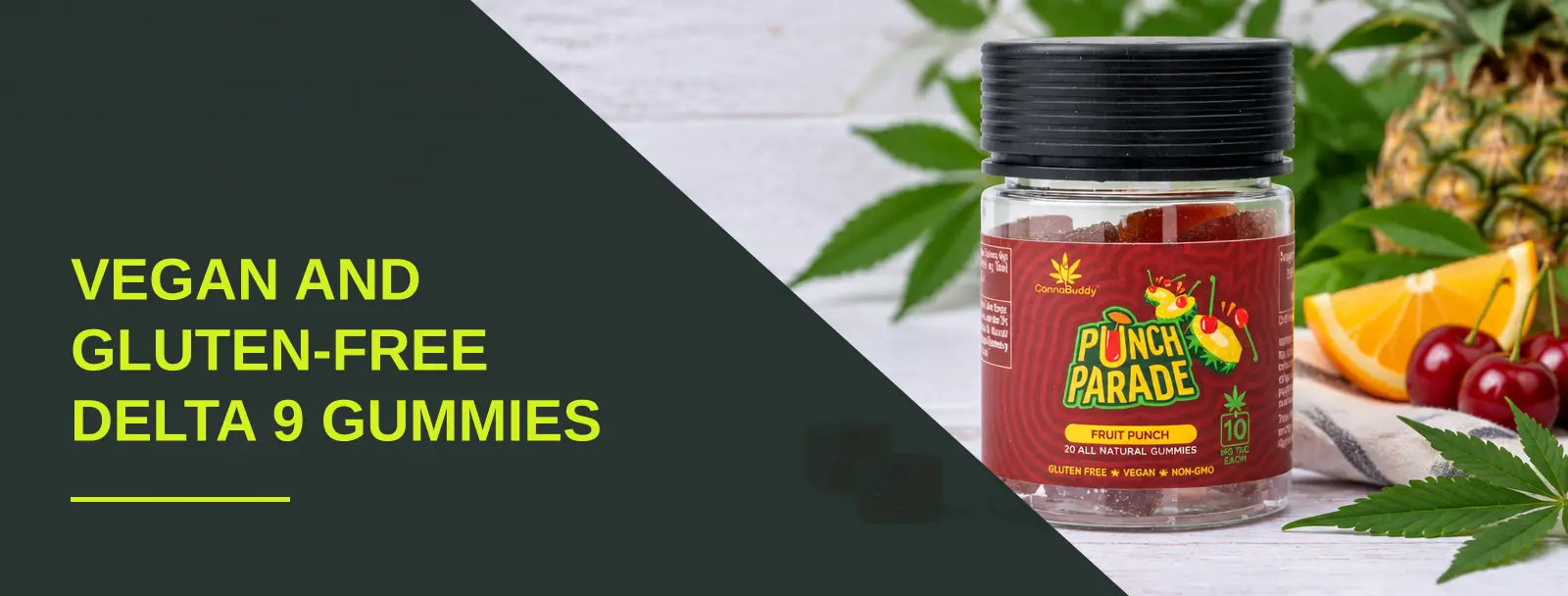
CannaBuddy house gummies are the only Delta 9 gummies in stock whose listings state both vegan and gluten-free (they also say non-GMO). Each has 10 mg of hemp-derived Delta 9 THC per gummy, comes in a 20-count or 2-count jar, and lists organic tapioca syrup, organic cane sugar and pectin. In stock now: Razz Dazzle, Sour Hour and Punch Parade.
Camino Sours has four listings that call the gummies vegan (Watermelon Spritz and Tropical Burst say "vegan gummy," Blackberry Dream says "a vegan, lab-tested formula," and Orchard Peach says "plant-based and vegan-friendly ingredients"). Each is a 10-piece package with pectin in the ingredients and a sour sugar coating. Per piece, Watermelon Spritz has 10 mg Delta 9 THC; Orchard Peach has 10 mg Delta 9 THC plus 10 mg CBD; Tropical Burst has 10 mg Delta 9 THC plus 5 mg THCv; and Blackberry Dream has 10 mg each of Delta 9 THC, CBD and CBN on its panel, though the description text on that page gives different amounts, so go by the label. None of these four prints a gluten-free claim. The four other Camino gummies in stock list gelatin in their ingredients, so they aren't on this list.
Wana has two gummies in stock, both described as melt-proof and vegan, both 10 pieces per package. Wana Inspire Raspberry Limeade lists 10 mg each of Delta 9 THC, CBD and CBG per piece. Wana Optimals gummies lists 10 mg CBD, 2 mg Delta 9 THC, 2 mg CBG, 2 mg CBN and 1 mg melatonin per piece. Neither listing prints a gluten-free claim.
3Chi has one Delta 9 gummy in stock: Orange Dreamsicle. The listing calls it vegan-friendly with no animal gelatin, and lists 20 pieces at 10 mg each (200 mg total). The nutrition panel lists a serving as half a piece, so the panel's 40 servings per container are half-gummy servings. No gluten-free claim is printed.
Not on this list. Four of the eight Wyld gummies in stock list gelatin in their ingredients, and the other four make no vegan claim, so none made the cut. Urb, Galaxy Treats and Kush Kube list pectin in their Delta 9 gummy ingredients, but none of those listings states vegan or gluten-free, so we're not calling them either. Cycling Frog and Mellow Fellow have no Delta 9 gummies in stock right now. Cheeba Chews are a taffy rather than a gummy, so they sit outside this roundup; their listings print "gluten free" but make no vegan claim.
Everything above lives in our Delta 9 gummies category if you'd rather browse than click one by one.
Dosing vegan Delta 9 gummies: start low, go slow
Nothing about pectin changes the rules here. A vegan Delta 9 gummy is still an edible, and edibles are slow.
If you're new, start with 2.5 to 5 mg (that may mean cutting a 10 mg gummy in half) and then wait. Give it two full hours, not thirty minutes. Oral THC typically takes 30 to 90 minutes to come on, with effects that can last four to eight hours or longer depending on the person and the dose (Grotenhermen, Clinical Pharmacokinetics, 2003). Taking a second piece at the 45-minute mark because "nothing's happening" is the most common way people turn a nice evening into a long one.
Eating a gummy with food, especially something with a little fat, can shift the timing too. There's more on this in our FAQ.
Start low, go slow, find your own sweet spot. It's a cliché because it works.
Vegan Delta 9 gummies FAQ
Are Delta 9 gummies vegan?
Some are. Pectin-based gummies usually qualify, but you still need to check the coating, the colorants, and the glycerin source. Finding "pectin" on the label is only the first step of the check.
Is pectin vegan?
Yes. It's a fiber extracted from fruit, mainly citrus peel and apple pomace. No animal involvement at any step.
Are vegan Delta 9 gummies also gluten-free?
Not automatically. Vegan is about animal ingredients; gluten-free is about wheat, barley, and rye. A pectin gummy can still use wheat-based glucose syrup or malt flavoring. Check both separately.
Do pectin gummies feel different from gelatin gummies?
Texture, yes. Pectin is softer with a shorter bite, and gelatin is bouncy and elastic. Effects, no. There's no research showing the gelling agent changes how oral THC is absorbed.
Are hemp-derived Delta 9 gummies legal?
They're federally permitted under the 2018 Farm Bill as long as Delta 9 THC stays at or below 0.3% by dry weight. A 10 mg gummy fits because the gummy itself weighs several grams. State and local rules vary, though, so check yours before ordering.
Your Plant-Based Shortlist
Reading a gummy label well comes down to two separate checks: the gelling agent and coating for vegan, and the syrup base and flavorings for gluten-free. Run both every time, and let the package in your hand have the final word.
Want the shortest path? Our CannaBuddy house gummies, like Punch Parade, are the only Delta 9 gummies we stock whose listings say both vegan and gluten-free. For more options, browse the Delta 9 gummies category, or stop by our Charlotte or Matthews store and we'll read the labels with you.